







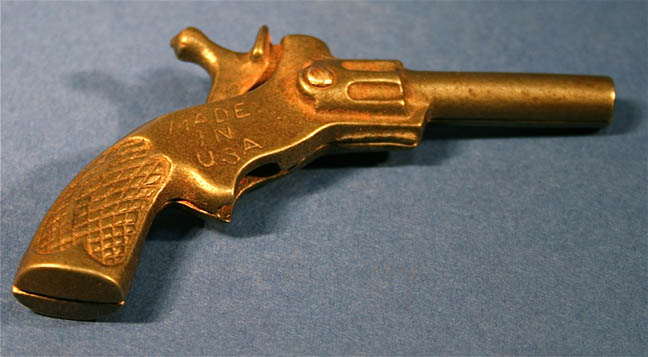
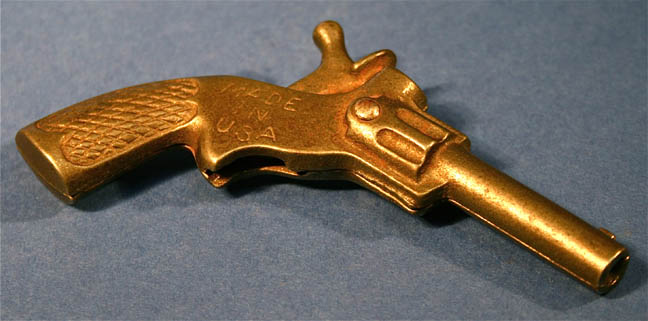

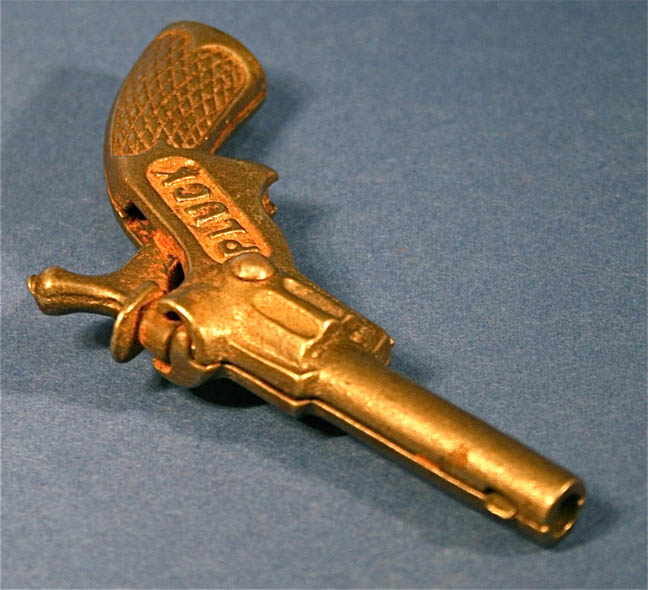
Title: Little Antique Cast-Iron Toy Hand Cap Gun Pistol By Pluck
Catalog Number: 4445
Category: Metals / Toys
Artist:
Country & Origin:
Historical Period: 20th Century
Approximate Date: 1930
Signature: Unsigned
Condition: Museum Quality
Size:
Height: 3 7/8 inches
Width: 2 inches
Depth: 1/2 inch
Weight:
Description & Provenance: 1930 Stevens "PLUCK" Cast Iron Cap Gun Pistol, Made in U.S.A. small pistol gun with embossed receiver and grip, This gun is called the Pluck. Vintage Toy Cap Gun says "PLUCK" on one side and MADE IN USA on other side. Both the Trigger (hammer) and Gun Cock work properly. It has a great aged patina to the toy. Gun and cap: A cap was placed between the shell and point before loading the cartridge into the chamber. Gun smoke produced by the exploded cap traveled through the hollow point and out the barrel of the gun for added realism. Little concern over children playing with realistic-looking toy guns could be heard at the time. In fact, boxes containing Nichols’ Stallion revolvers were marked “Recommended by Parents Magazine.” Cap guns once topped every boy’s Christmas wish list. Boys growing up in America in the 1940s and ’50s were like Ralphie, the 9-year-old in the movie A Christmas Story, whose only desire was to own a Daisy brand Red Ryder repeating BB carbine. Protective mothers, of course, cautioned, “You’ll shoot your eye out.” The alternative – acceptable to both parents and young children – was the cap pistol. American toy makers mastered cast iron production in the 1870s and were soon marketing this all-American toy as part of a greater range of playthings that included horse-drawn wagons, kitchen stoves and scale-model sewing machines. While some early cast-iron cap guns resembled small pocket pistols of the era, others featured animated devices and were not intended to resemble real firearms. When fired, the animated cap pistol performed an action similar to that of a mechanical bank.
Origin, Encyclopedia & Researched Articles:
Encyclopedia Name: http://en.wikipedia.org/wiki/Toy_gun
Toy weapons are toys that mimic real weapons, but are designed to be fun for children to play with and less dangerous. Some are essentially similar to the real thing, but less powerful. Weapons for cutting and stabbing have dull blades usually in plastic. Weapons formerly made out of metal and wood are now often made of a lighter material such as plastic. Toy guns either cannot really shoot projectiles or just soft ones such as cork shooting pop guns or Nerf darts with limited velocity. However, cap pistols use caps with extremely small amounts of explosives for the sound effect. Toy hand grenades do not contain explosives except for a cap. BB guns are often called toy guns, but their shots can cause bodily harm. Many newer toy weapons are brightly colored and oddly shaped to appeal to children and distinguish them from the real thing. For example, a toy that shoots Nerf balls might have a rounded shape and a neon yellow color. For big weapons, the toy version is usually on a smaller scale. It might be much smaller, such as a toy catapult that is 20 centimetres (8 in) tall. Or it might just be sized for children, such as a squirt gun that is half the size of a similar firearm. A prop weapon (such as a stage gun or a stage sword) has to look real, but like a toy weapon, it should not be dangerous. A woodworking business, the Parris Manufacturing Company was contracted by the United States Government to provide over 2 million accurate copies of the M1903 Springfield rifles for the large World War II US armed forces. After the war they manufactured and sold their replicas to drill teams and to children as toy guns.
Verbal History:
Development of the motion picture industry around the turn of the 20th century and the popularity of the Western film genre went a long way in creating demand for realistic toy pistols. In less than 12 minutes, the 1903 Edison film The Great Train Robbery depicted the timeless struggle of good versus bad, and virtue versus evil – punctuated by wild gunplay.
Movie cowboys like William S. Hart and Tom Mix soon galvanized a romantic image of “good guys” taming the Wild West. To emulate their heroes, children needed realistic toy pistols. Demand increased with the development of “talkies” and the arrival of singing cowboys to the silver screen. Until then cap guns were often marked with generic names like “Chief,” “Buster,” “Ranger” and “Scout.”
Kenton Hardware Co. of Kenton, Ohio, had produced cap pistols and other cast-iron toys since about 1894. Among its popular models prior to 1930 was the Buffalo Bill cap pistol. By the mid-1930s Kenton was producing a realistic-looking Police Chief model and a snub-nosed Police Chief Jr. revolver.
Early in 1938 Kenton Hardware Co. introduced a new and improved cap gun, the Gene Autry repeating cap pistol. Using Gene Autry’s pearl-handled six-shooters as the model, Kenton pattern maker Joe Solomon had scaled down the size of the cap pistol to 70 percent of the originals. Sales of the new pistols shot through the roof, prompting Kenton to hire extra workers to meet demand. Kenton shut down during World War II, but in the postwar era resumed production of Gene Autry cap guns, which they marketed until the early 1950s.
Starting in the 1920s, Kilgore, of Westerville, Ohio, manufactured vehicles, boats and planes, but cast-iron cap pistols remained the toy company’s mainstay. Kilgore introduced its Lone Ranger cap guns about the same time as Kenton came out with the Gene Autry pistol. Kilgore also made a cast-iron Roy Rogers gun that is highly prized. Unlike Kenton, Kilgore successfully converted to die-cast production after the war. Kilgore also produced both disc and roll caps for use in most toy guns.
James L. Dundas, author of Cap Guns: With Values (Schiffer Publishing Ltd., 1997), recalls most of the cap guns from his childhood were made of die-cast zinc alloys. “Once in a while you would come across a kid who had a cast-iron cap gun. Oh, you’d about want to trade your shoes for it, because it was more like a real gun,” said Dundas, who was born in 1940. His favorite cap guns were the Long Tom and the American, both classic cast-iron pistols made by Kilgore. “I had to trade scads of stuff plus cash to get those cap guns,” said Dundas, who has bought back most of his childhood toys.
Cast iron’s long run as the toy makers’ metal of choice came to an end with the outbreak of World War II. Soon all metal went to the war effort. After the war, toy companies made the transition from cast iron to die-cast zinc alloys, sometimes referred to as pot metal, which was less costly to produce and ship.
Hubley, which had manufactured cast-iron toys since the 1890s, was another leading producer of cap guns. The Lancaster, Pa., company transitioned to die-cast toys after the war. Hubley produced more than 11 million cap pistols in 1952, many of which were their Cowboy and Texan models. Jim Manning, a toy dealer from Swanton, Ohio, said Hubley’s nickel-plated Cowboy was one of the best-selling cap pistols ever produced. “It’s copied after the real Colt .45. I’m sure they even had to get the rights to make that gun because it’s so close a copy,” he said.
All Metal Products Co., better known as Wyandotte Toys, Wyandotte, Mich., introduced its Hopalong Cassidy cap pistols after the war. Hoppy’s picture and facsimile autograph appear engraved much like scrimshaw on the faux-ivory handles. Wyandotte’s guns can sometimes be identified by a “Y&.” logotype on the handles. Gold-plated guns with Hopalong Cassidy’s image printed in white on black plastic grips are considered rare.
Esquire Novelty Co. of Jersey City, N.J., used pistols manufactured by Actoy in its Official Wyatt Earp set. The box pictured Hugh O’Brian, who played the famous U.S. marshal in the ABC television series The Life and Legend of Wyatt Earp (1955-1961). Esquire Novelty also sold a Wyatt Earp Buntline Special model like O’Brian carried, which featured ricochet sound effects and had an extra-long barrel. This die-cast cap gun sold for 98 cents. Esquire also marketed a Rin Tin Tin cap pistol outfit based on the popular television series of the mid-1950s starring the famous German shepherd wonder dog.
Leslie-Henry Manufacturing Co. in Mount Vernon, N.Y., began manufacturing die-cast Gene Autry cap pistols around 1952. The company also produced U.S. Marshall, Wagon Train and Wild Bill Hickok models.
George Schmidt Manufacturing Inc., Los Angeles, best known for its Roy Rogers die-cast cap pistols, also marketed Dale Evans guns for young cowgirls, named for Rogers’ wife and onscreen co-star. Schmidt also produced an Alan Ladd “Shane” model circa 1953 and a Davy Crockett model in its Pathfinder style circa 1955.
Brothers Talley and Lewis Nichols dreamed of starting their owner company as soon as they got out of the service after World War II. Returning home to Texas, they founded Nichols Industries Inc. At a small factory in Pasadena, near Houston, the brothers produced their first die-cast cap gun, the Silver Pony model, in 1946. They followed with the Silver Mustang and Silver Colt, all modeled after the Colt .45. These early guns led to the groundbreaking Stallion line of the 1950s. Introduced at the 1950 Toy Fair, the Stallion 45 featured cartridges that fired caps. Many people hailed this large six-shooter the outstanding toy of the year. Nichols’ production capacity for an entire year was sold out within a few days.
The Korean War and subsequent supply shortages delayed Nichols’ introduction of their Stallion 38 to 1954. The new, smaller Stallion outsold the Stallion 45 because it was less expensive than the original model while packing the same high-quality workmanship and realism. A cap was placed between the shell and point before loading the cartridge into the chamber. Gun smoke produced by the exploded cap traveled through the hollow point and out the barrel of the gun for added realism.
Little concern over children playing with realistic-looking toy guns could be heard at the time. In fact, boxes containing Nichols’ Stallion revolvers were marked “Recommended by Parents Magazine.”
Introduction of the smaller Stallion 32 in 1955 raised the bar for Nichols. Operations moved to a new plant in Jacksonville, Texas, where production records were set with the help of 200 additional employees.
The Nichols family sold the company in 1965 to Kusan of Nashville, Tenn. Guns produced after that point were not of the same excellent quality as their predecessors.
Cap gun manufacturers reached the end of the trail in the 1960s as old-time Western film stars faded into the sunset and TV networks canceled all but the most popular Western series. Toy companies that banked solely on the popularity of cap guns and Westerns fell by the wayside.
Mattel made several attractive die-cast guns in the late 1950s and early ’60s. Its Shootin Shell 45 and Fanner 50 pistols actually fired “safe” plastic bullet noses as well as caps.
Despite their good looks and innovations, however, cap guns quickly became passé and all but disappeared from store shelves.
Dundas, a retired college professor, blames violence in society and how it is depicted in the media for the demise of toy guns. “Am I in favor of getting rid of the (toy) guns? No. I am in favor of getting rid of some of the violence on television,” he said. “Roy Rogers would shoot at a guy, but he’d shoot the gun out of his hand. If kids would watch that movie now they would say, ‘No way!’ They want to see the guy get shot in the eye.”


Comments are subject to review
Be the first to comment!