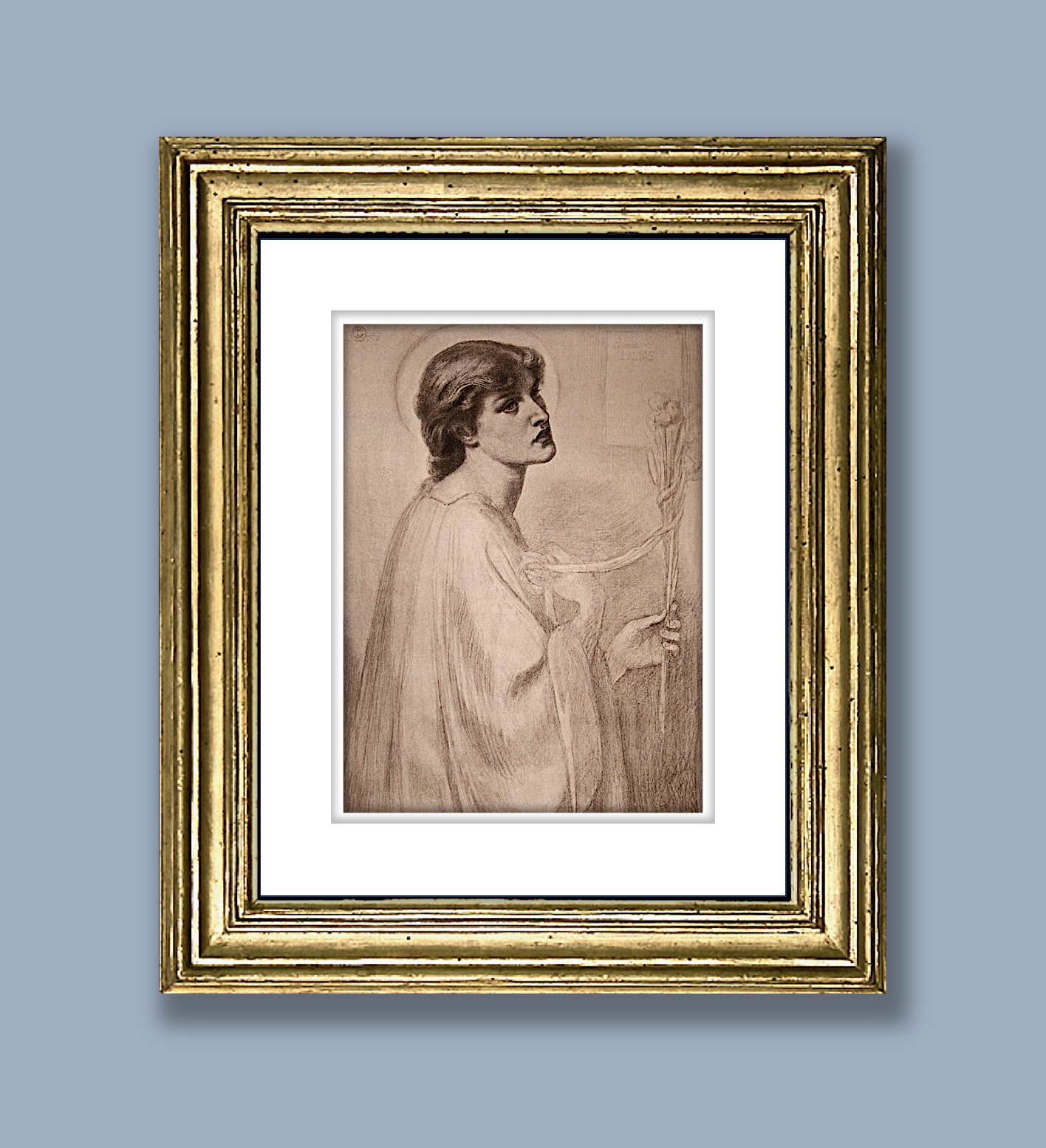


Title: Pre-Raphaelite Art - Work on paper By Artist D G Rossetti
Shipping: $18.00
Artist: N/A
Period: 19th Century
History: N/A
Origin: Northern Europe > England
Condition: Very Good
Item Date: 1800s
Item ID: 1400
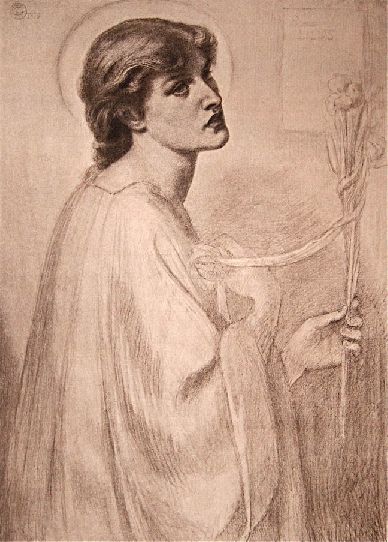
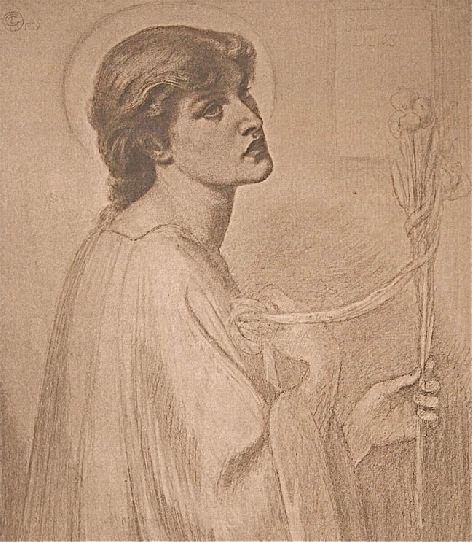
This work on paper print, Sancta LILIAS, is by the artist D. G. Rossetti. Details: G. F. Watts, pinxit. Swan Electric Engraving Co., circa 1920s. Figure monogram and date in the upper left corner: "1879." Inscribed on a scroll in the upper right: "Sancta LILIAS." The print depicts a three-quarter-length figure of a woman—bearing the features of Alexa Wilding—standing and turned to the right, with her head, nearly in profile, adorned with a halo. In her left hand, she holds a lily stem. The head is finely finished in red chalk, while the rest of the figure is sketched. According to Surtees, comparison of the two works shows that this print is essentially an unfinished replica, though a fine one in its own right. Other works from 1879 include a crayon replica with variations of Pandora, in the possession of Mr. Watts-Dunton; the large Leyland replica of The Blessed Damozel, held by the Hon. Mrs. O’Brien; and a very popular crayon study known as Sancta Lilias, as indicated by a label in the corner. It is believed that this piece may have been intended for an Annunciation subject different from Rossetti’s previously executed works. The angel or female saint in the image holds a bunch of lily stems, around which a ribbon is wound, inscribed with “Aspice Lilia!” During 1880 and 1881, Rossetti was occupied with three large original pictures—The Day Dream, The Salutation of Beatrice, and La Pia—as well as Found, which had been re-commissioned by Mr. William Graham. He also worked on several replicas, the most notable being the smaller Dante’s Dream with two predellas, delivered early in 1880 for Mr. Graham to replace the large original. Following Mr. Graham’s death in 1886, this picture passed into new ownership.
Sancta LILIAS is a work by Dante Gabriel Rossetti, created in 1879 and later reproduced as a print by Swan Electric Engraving Co. in the 1920s. The figure, modeled on Rossetti’s muse Alexa Wilding, depicts a female saint or angel holding a lily, symbolizing purity, with her head haloed and rendered in delicate red chalk while the rest of the figure remains sketched. This piece is considered an unfinished replica, reflecting Rossetti’s practice of producing multiple studies and variations of his works for patrons and collectors. During this period, Rossetti was engaged with several major projects, including The Day Dream, The Salutation of Beatrice, and La Pia, as well as commissioned replicas like the smaller Dante’s Dream. Sancta LILIAS, with its lyrical elegance and symbolic detail, exemplifies Rossetti’s preoccupation with the interplay of beauty, spirituality, and poetic narrative in his late 19th-century work.
Link: http://en.wikipedia.org/wiki/Dante_Gabriel_Rossetti
The son of émigré Italian scholar Gabriel Pasquale Giuseppe Rossetti and his wife Frances Polidori, D.G. Rossetti was born in London, England and originally named Gabriel Charles Dante Rossetti. His family and friends called him "Gabriel", but in publications he put the name Dante first (in honor of Dante Alighieri). Like all his siblings, he aspired to be a poet and attended King's College London. However, he also wished to be a painter, having shown a great interest in Medieval Italian art. He studied at Henry Sass's Drawing Academy from 1841 to 1845 when he enrolled at the Antique School of the Royal Academy, leaving in 1848. After leaving the Royal Academy, Rossetti studied under Ford Madox Brown, with whom he was to retain a close relationship throughout his life. Rossetti was always more interested in the Medieval than in the modern side of the movement. He was publishing translations of Dante and other Medieval Italian poets, and his art also sought to adopt the stylistic characteristics of the early Italians. Rossetti increasingly preferred symbolic and mythological images to realistic ones. This was also true of his later poetry. Many of the ladies he portrayed have the image of idealized Botticelli's Venus, who was supposed to portray Simonetta Vespucci. Rossetti, was inspired by the art in the 1850s. His visions of Arthurian romance and medieval design also inspired his new friends of this time, William Morris and Edward Burne-Jones. Rossetti also typically wrote sonnets for his pictures, such as "Astarte Syraica". As a designer, he worked with William Morris to produce images for stained glass and other decorative devices. Both these developments were precipitated by events in his private life, in particular by the death of his wife Elizabeth Siddal. She had taken an overdose of laudanum shortly after giving birth to a stillborn child. Rossetti became increasingly depressed, and buried the bulk of his unpublished poems in his wife's grave at Highgate Cemetery, though he would later have them exhumed. He idealised her image as Dante's Beatrice in a number of paintings, such as Beata Beatrix. These paintings were to be a major influence on the development of the European Symbolist movement. In these works, Rossetti's depiction of women became almost obsessively stylised. He tended to portray his new lover Fanny Cornforth as the epitome of physical eroticism, whilst another of his mistresses Jane Burden, the wife of his business partner William Morris, was glamorised as an ethereal goddess.