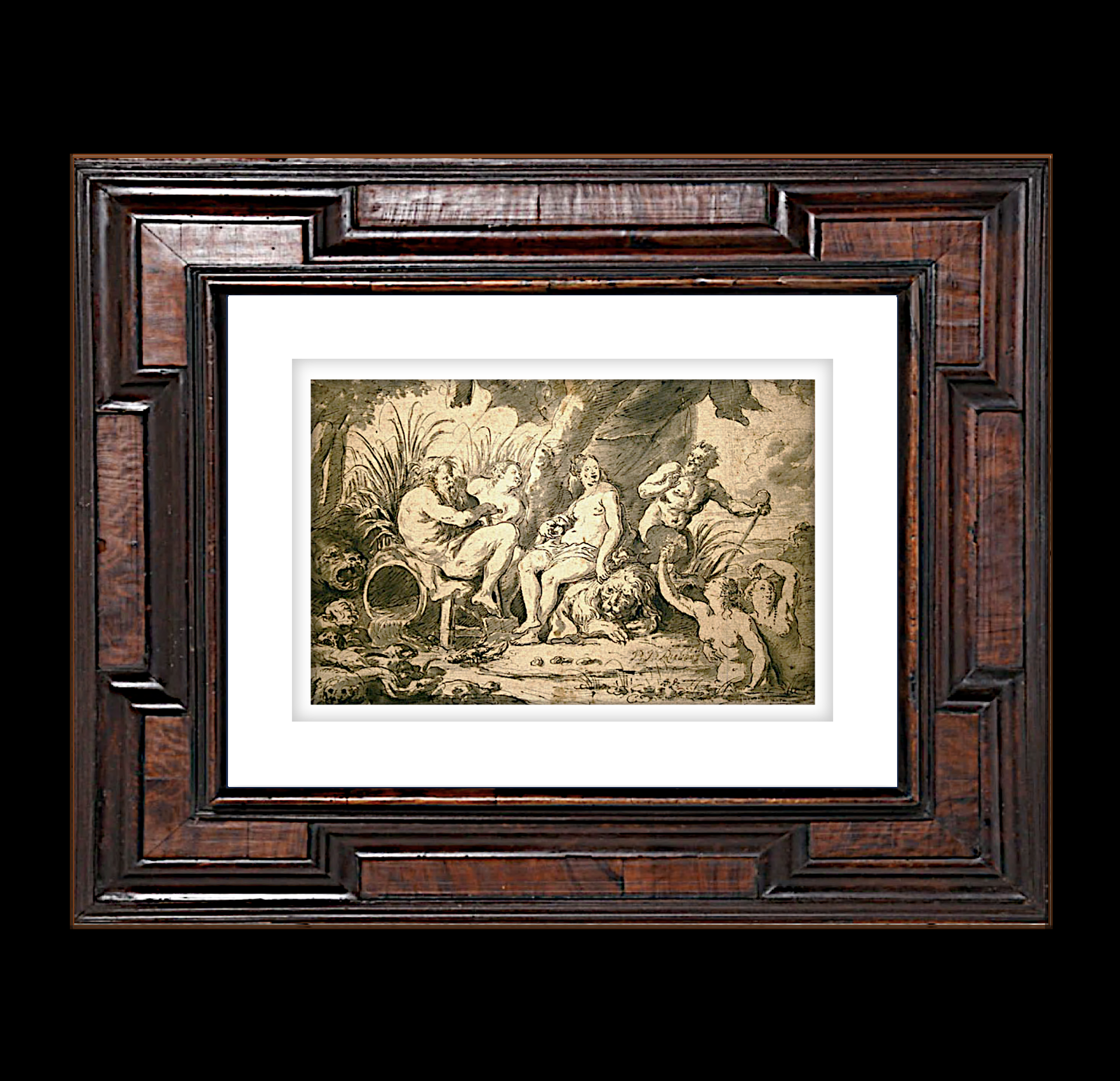


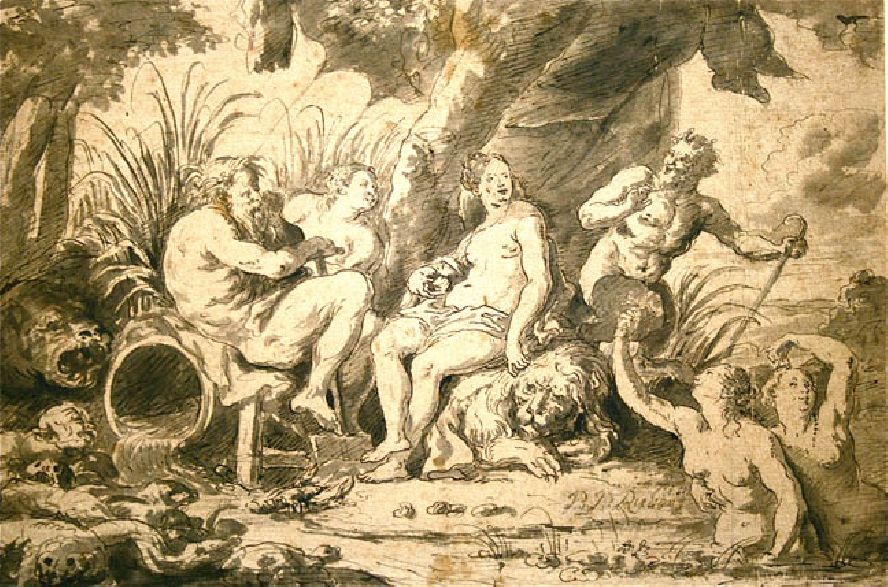
Title: Antique Ink Wash Sketch Drawing Nymphs & Satyrs By Ruben
Shipping: $39.00
Artist: N/A
Period: 16th Century
History: N/A
Origin: Central Europe > Belgium
Condition: Museum Quality
Item Date: 1600 to ?
Item ID: 2326
Antique Ink Wash Sketch of Nymphs & Satyrs, Peter Paul Rubens (Flemish, 1577–1640) This is an original ink wash sketch on tan laid paper, depicting nymphs and satyrs in a dynamic composition. Executed in black and gray wash, it is believed to have been initiated by a studio assistant, with Rubens himself refining the drawing using brush and gray ink. The piece is possibly signed by the artist in the lower right corner, marked P.P. Rubens? Sketches like this were often preparatory studies for larger compositions, and this work is no exception, forming part of a series of studies exploring themes of mythological figures. What makes this drawing especially compelling is how it reflects the interplay of artistic ownership, collaboration, and replication in Rubens’ studio—an important facet of early modern European art practices. The medium, gray ink wash on very old paper, showcases the masterful use of dry brush technique combined with textured paper, producing a depth and atmosphere full of mystery and vitality. Despite its age, the paper remains remarkably well-preserved. Many similar drawings were lost over the centuries, often destroyed in the name of decency, making surviving examples particularly precious. These studies reveal the extraordinary skill of the great masters, whose preliminary drawings informed some of their most celebrated paintings. Rubens and his contemporaries were influenced by travels and exchanges between Northern and Southern Europe, particularly Italy, where exposure to Italian art and antique sculpture enriched their practice. Works on paper, including drawings and prints, played a critical role in circulating artistic ideas across regions. These exchanges shaped drawing practices, education, depictions of the human body, narrative subjects, and printmaking techniques, highlighting both collaborative and independent modes of artistic production. Drawing the human form was a fundamental part of artistic training from the Renaissance onward. Artists in the Netherlands and Italy approached this challenge differently, reflecting their respective traditions, yet all grappled with representing the body from life or antique models and mastering light and shadow. This sketch is a fascinating example of that ongoing artistic dialogue, capturing both the technical rigor and imaginative spirit of Rubens’ studio. Medium: Gray ink wash on laid paper Condition: Excellent considering age; paper remains relatively fresh Provenance: Part of a series of preparatory sketches
Original works on paper, such as drawings, sketches, and preparatory studies, hold tremendous historical value today because they provide direct insight into an artist’s creative process, technique, and working methods. Unlike finished paintings, these works reveal the evolution of ideas, compositional experimentation, and problem-solving that underpinned masterworks, offering an intimate glimpse into the studio practices of the past. They also reflect broader artistic, cultural, and intellectual exchanges—showing how Northern and Southern European artists influenced one another through the circulation of prints, sketches, and drawings. Surviving examples are rare, as many were lost over time due to fragility, changing tastes, or destruction, making them highly prized by collectors, museums, and scholars. Beyond their aesthetic appeal, works on paper serve as crucial documents of art history, preserving the legacy of great masters and illuminating the evolution of styles, iconography, and the technical innovations that shaped Western art.
Link: http://en.wikipedia.org/wiki/Ink_and_wash_painting
Grinding ink in water. artists from around the world spend years practicing basic brush strokes to refine their brush movement and ink flow. In the hand of a master, a single stroke can produce astonishing variations in tonality, from deep black to silvery gray. Indeed, Oriental sumi-e has long inspired modern artists in the West. In his classic book Composition, American artist and educator Arthur Wesley Dow (1857–1922) wrote this about sumi-e: "The painter ...put upon the paper the fewest possible lines and tones; just enough to cause form, texture and effect to be felt. Every brush-touch must be full-charged with meaning, and useless detail eliminated. Put together all the good points in such a method, and you have the qualities of the highest art". Dow’s fascination with sumi-e not only shaped his own approach to art but also helped free many American modernists of the era, including his student Georgia O’Keeffe, from what he called a 'story-telling' approach. Dow strived for harmonic compositions through three elements: line, notan, and color. He advocated practicing with Oriental brushes and ink to develop aesthetic acuity with line and notan. Wash painting developed in China during the Tang Dynasty (618-907). Wang Wei is generally credited as the painter who applied color to existing ink and wash paintings. The art was further developed into a more polished style during the Song Dynasty (960-1279). It was introduced to Korea shortly after China's discovery of the ink. Then, the Korean missionaries in Japan, in helping the Japanese establish a civilized settlement introduced it to Japan in the mid-14th century.