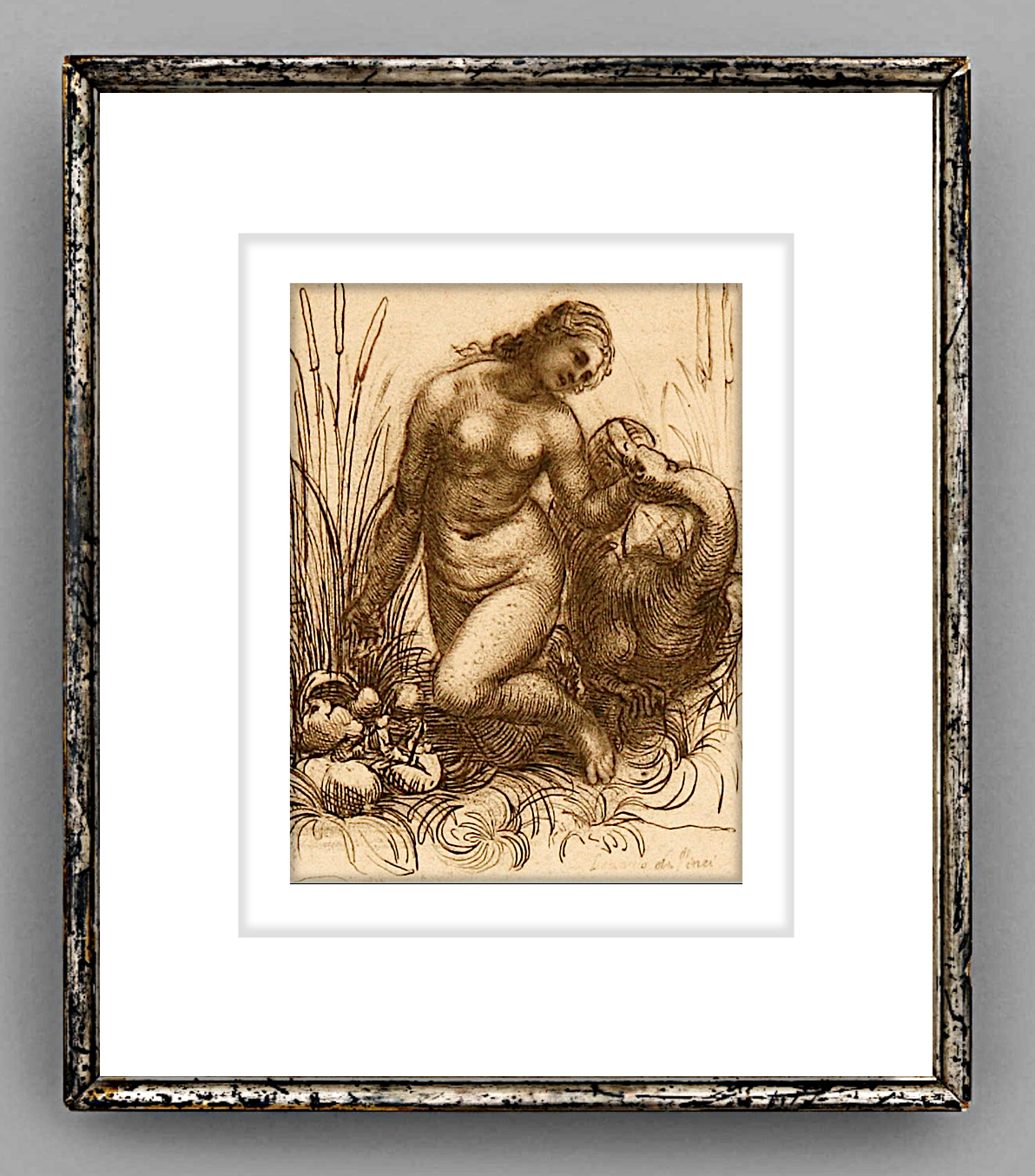



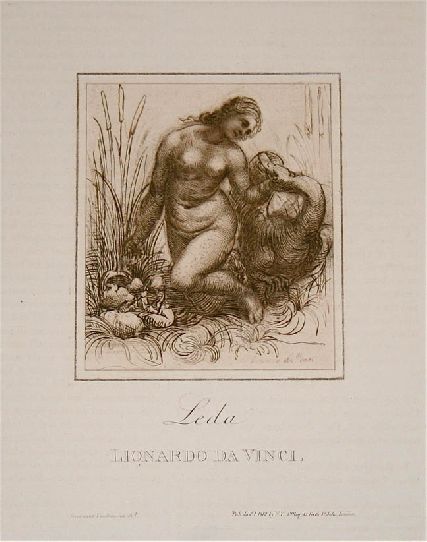
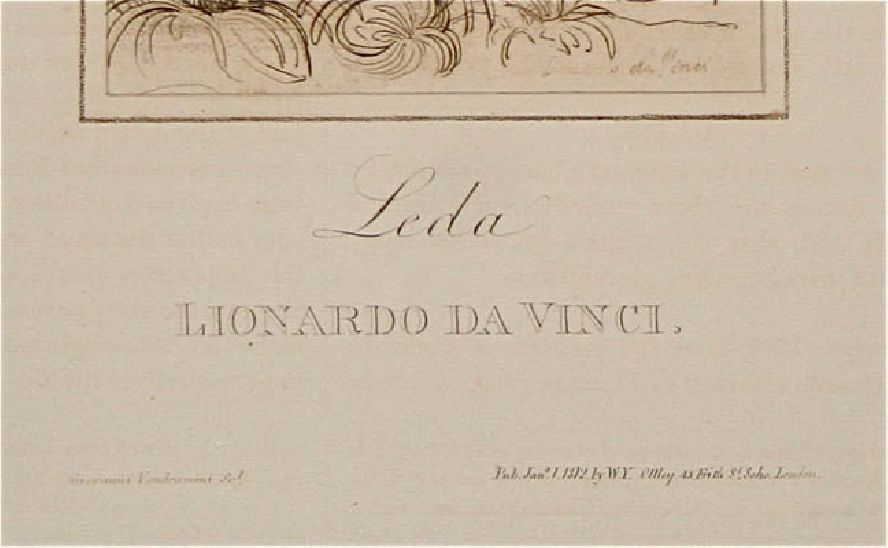
Title: Leda - 1812 Old Book Page Print - By Artist Leonardo Da Vinci
Shipping: $29.00
Artist: N/A
Period: 19th Century
History: N/A
Origin: Southern Europe > Italy
Condition: Good
Item Date: 1812
Item ID: 4856
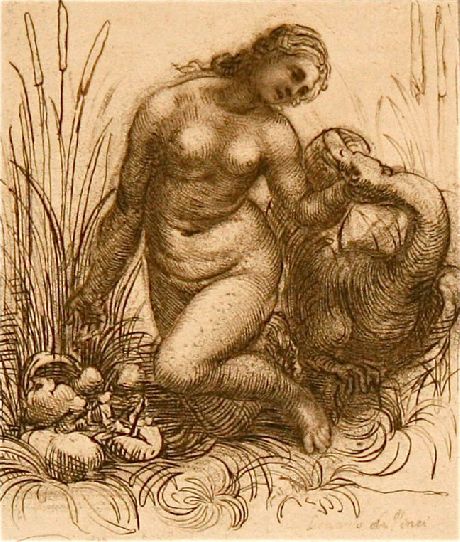
Antique Art Print: Study for the Kneeling Leda (c. 1505–1507) This antique art print is based on Study for the Kneeling Leda, a preparatory work related to the lost painting Leda and the Swan (c. 1503–1507) by Leonardo da Vinci. Artist: Leonardo da Vinci (Italian, 1452–1519) Date: c. 1503–1507 Technique: Pen and ink with wash over black chalk on paper Dimensions: 160 × 139 mm Type: Mythological graphic art Location: Devonshire Collection, Chatsworth In this study for the now-lost painting, Leonardo combines his mastery of draftsmanship with his deep knowledge of human anatomy—including his studies of human reproduction—and his lifelong fascination with movement and flight. The myth of Leda and her swan companion likely appealed to Leonardo’s subtle sense of wit and curiosity, allowing him to explore both sensuality and transformation within a classical narrative. Leonardo’s notebooks further reveal that he was also planning an alternative composition depicting Leda in a seated pose, underscoring his ongoing experimentation with form, gesture, and mythological subject matter. Lithography is a printmaking technique based on the natural repulsion between oil and water, developed in the late 18th century and widely adopted by artists in the 19th and 20th centuries. The artist draws directly onto a flat limestone surface or metal plate using a greasy crayon or ink, after which the surface is chemically treated so that the drawn areas retain ink while the non-image areas attract water and repel ink. When the stone or plate is moistened and rolled with oil-based ink, the ink adheres only to the drawn image, which is then transferred onto paper under pressure. Lithography is prized for its ability to capture the immediacy, subtlety, and expressive quality of drawing, allowing for rich tonal variation and fluid, painterly effects.
The myth of Leda and the Swan originates in Greek mythology and tells of Zeus, who transforms himself into a swan to seduce—or, in some versions, assault—Leda, the queen of Sparta. From this union Leda gives birth to remarkable offspring, including Helen of Troy, whose beauty would later ignite the Trojan War, as well as Castor and Pollux. The story blends themes of divine transformation, fertility, and the blurred boundary between the mortal and the godly, making it a powerful subject in classical art and literature. For Leonardo da Vinci, the myth offered an ideal framework to unite classical learning with his scientific curiosity. Around 1503–1507, Leonardo developed multiple studies of Leda, exploring both standing and kneeling poses, and focusing on the interaction between the human body and the swan. The subject allowed him to investigate anatomy, movement, and the generative forces of nature—interests reflected in his studies of reproduction and natural phenomena. Although Leonardo’s finished painting of Leda and the Swan is now lost, his drawings profoundly influenced later artists, and the theme became a lasting symbol of Renaissance fascination with classical mythology, sensuality, and the harmony between nature and the human form.
http://en.wikipedia.org/wiki/Leonardo_da_Vinci
Leonardo di ser Piero da Vinci pronunciation (help·info)) (April 15, 1452 May 2, 1519) was an Italian polymath: painter, sculptor, architect, musician, scientist, mathematician, engineer, inventor, anatomist, geologist, cartographer, botanist and writer. Leonardo has often been described as the archetype of the Renaissance Man, a man of "unquenchable curiosity" and "feverishly inventive imagination". He is widely considered to be one of the greatest painters of all time and perhaps the most diversely talented person ever to have lived. According to art historian Helen Gardner, the scope and depth of his interests were without precedent and "his mind and personality seem to us superhuman, the man himself mysterious and remote". Marco Rosci points out, however, that while there is much speculation about Leonardo, his vision of the world is essentially logical rather than mysterious, and that the empirical methods he employed were unusual for his time. Born the illegitimate son of a notary, Piero da Vinci, and a peasant woman, Caterina, at Vinci in the region of Florence, Leonardo was educated in the studio of the renowned Florentine painter, Verrocchio. Much of his earlier working life was spent in the service of Ludovico il Moro in Milan. He later worked in Rome, Bologna and Venice and spent his last years in France, at the home awarded him by Francis I. Leonardo was and is renowned primarily as a painter. Among his works, the Mona Lisa is most famous and most parodied portrait and The Last Supper the most reproduced religious painting of all time, with their fame approached only by Michelangelo's Creation of Adam. Leonardo's drawing of the Vitruvian Man is also regarded as a cultural icon,[4] being reproduced on everything from the euro to text books to t-shirts. Perhaps fifteen of his paintings survive, the small number due to his constant, and frequently disastrous, experimentation with new techniques, and his chronic procrastination. Nevertheless, these few works, together with his notebooks, which contain drawings, scientific diagrams, and his thoughts on the nature of painting, compose a contribution to later generations of artists only rivalled by that of his contemporary, Michelangelo. Leonardo is revered. for his technological ingenuity. He conceptualised a helicopter, a tank, concentrated solar power, a calculator, the double hull and outlined a rudimentary theory of plate tectonics. Relatively few of his designs were constructed or were even feasible during his lifetime, but some of his smaller inventions, such as an automated bobbin winder and a machine for testing the tensile strength of wire, entered the world of manufacturing unheralded. As a scientist, he made important discoveries in anatomy, civil engineering, optics, and hydrodynamics, but his failure to publish his findings meant that he influence on these fields is not well documented by historians.