







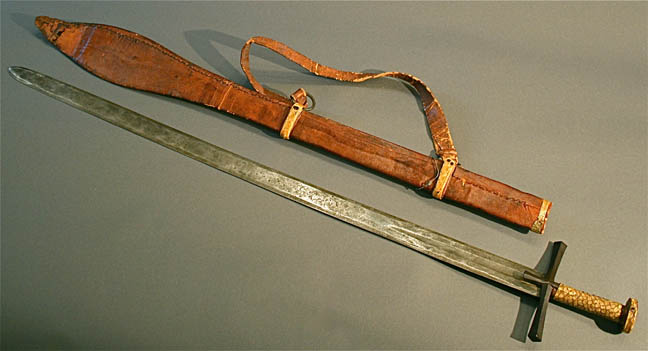
Title: African Dagger Sudan Tabuka Sword & Leather Scabbard Weapon
Catalog Number: 4929
Category: Metals / Weapons
Artist:
Country & Origin:
Historical Period: 19th Century
Approximate Date: 1800 to 1900
Signature: Unsigned
Condition: Museum Quality
Size:
Height: 40 inches
Width:
Depth:
Weight:
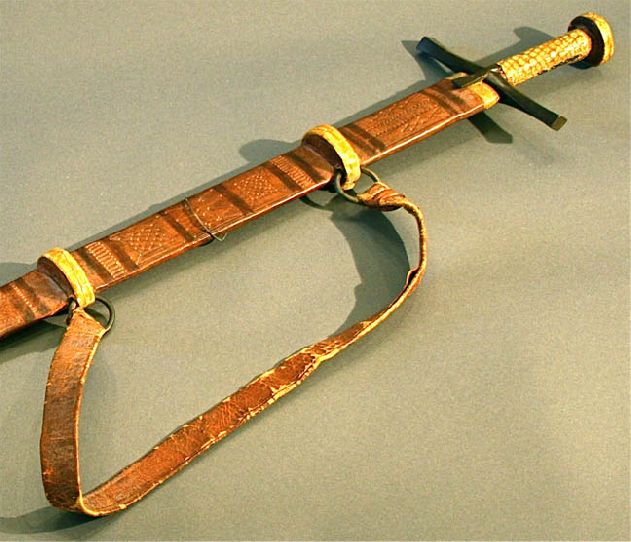
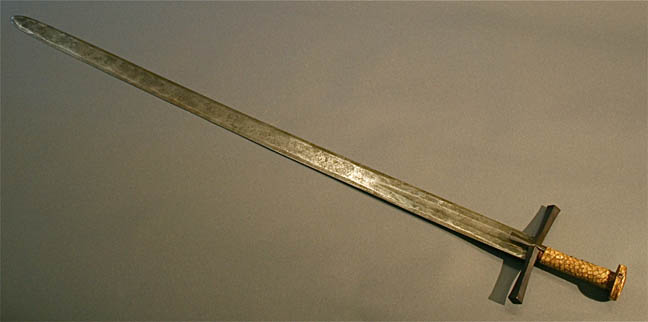
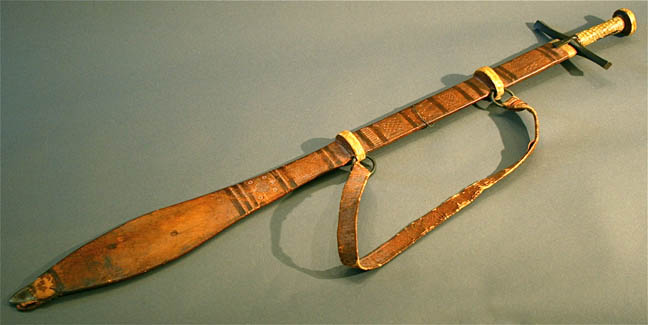
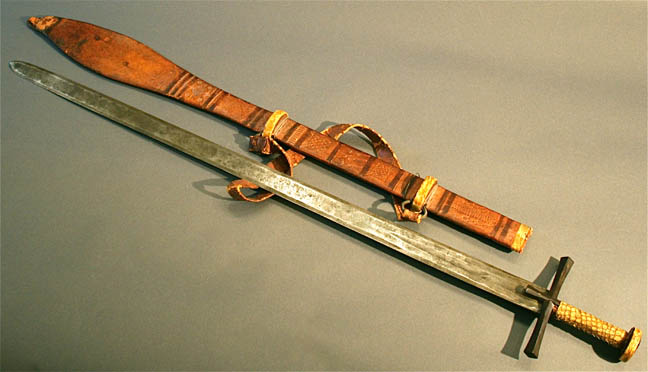
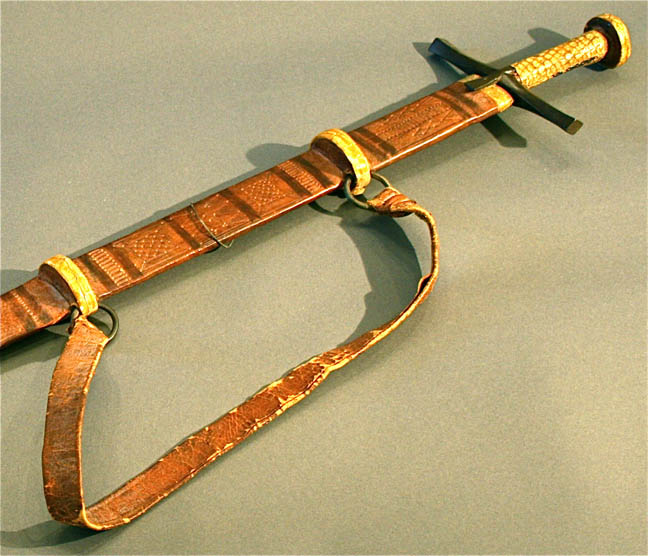
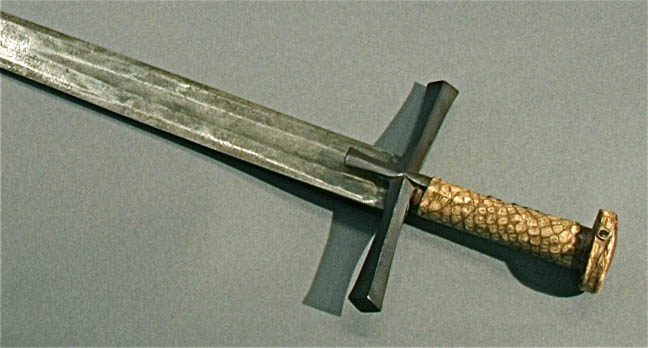
Description & Provenance: This is a magnificent antique african Sudan sword weapon. Sudanese 19th century Kaskara sword and scabbard. Straight Sword, Western Sudan / 'sub-Saharan: central and western Sahara the Tuareg brandished a highly specialized straight sword called the tabuka, since at least the 11th century. Pioneers in iron and steel the a Sudanese blacksmiths had, all types of magical powers when making a great weapon. Sudanese 19th century Kaskara sword scabbard, tooled leather with steel rings for leather shoulder strap and brass chape. Sword; African, Sudan, Kaskara, Cruciform Hilt, 2-Edged Blade, Scabbard, Around 40 inches Long. This is a Fine old piece of the turn of the century (1900) This is a hand made Double-edged blade. The cross guard is made of brass, the wooden hilt with covering from snake and animal hide. The unusual sword is in good condition.
Origin, Encyclopedia & Researched Articles:
Encyclopedia Name: http://en.wikipedia.org/wiki/Sword
A sword is a bladed weapon (edged weapon) used primarily for cutting or thrusting. The precise definition of the term varies with the historical epoch or the geographical region under consideration. In the most narrow sense, a sword consists of a blade with one or two edges, a hilt, and a crossguard. But in some cases the term may also refer to weapons without crossguard, or with only a single edge (backsword).
The basic principles of swordsmanship have remained fairly constant through the centuries, but the actual techniques vary among cultures and periods as a result of the differences in blade design and purpose. The names given to many swords in mythology, literature, and history reflect the high prestige of the weapon and the wealth of the owner. The sword is said to be the emblem of military honor and should incite the bearer to a just and generous pursuit of honor and virtue. It is symbolic of liberty and strength. In the Middle Ages, the sword was often used as a symbol of the word of God.
Historically, the sword developed in the Bronze Age, evolving from the dagger; the earliest specimens date to ca. 1600 BC. The Iron Age sword remained fairly short and without a crossguard. The spatha as it developed in the Late Roman army became the predecessor of the European sword of the Middle Ages, at first adopted as the Migration period sword, and only in the High Middle Ages developed into the classical Arming sword with crossguard. In the Early Modern period, the sword developed into the rapier and eventually the smallsword, surviving into the 18th century only in the role of dueling weapon. By the 19th century, swords were reduced to the status of either ceremonial weapon or sport equipment in fencing.
Non-European weapons called "sword" include single-edged weapons such as the Middle Eastern saif, the Chinese dao and the related Japanese katana; these would more accurately be described as sabres or backswords, but their high prestige in their respective cultures favoured the use of "sword". The Chinese jian is an example of a non-European double-edged sword, like the European models derived from the double-edged Iron Age sword.
The word sword comes from the Old English sweord, cognate to Old High German swert, Old Norse sverð, from a Proto-Indo-European root *swer- "to wound, to cut"
From around 1300 to 1500, in concert with improved armour, innovative sword designs evolved more and more rapidly. The main transition was the lengthening of the grip, allowing two-handed use, and a longer blade. By 1400, this type of sword, at the time called langes Schwert (longsword) or spadone, was common, and a number of 15th and 16th century Fechtbücher offering instructions on their use survive. Another variant was the specialized armour-piercing swords of the estoc type. The longsword became popular due to its extreme reach and cutting and thrusting abilities.
The estoc became popular because of its ability to thrust into the gaps between plates of armour. The grip was sometimes wrapped in wire or coarse animal hide to provide a better grip and to make it harder to knock a sword out of the user's hand.
A number of manuscripts covering longsword combat and techniques dating from the 13th–16th centuries exist in German, Italian, and English, providing extensive information on longsword combatives as used throughout this period.
Verbal History:
A scabbard is a sheath for holding a sword, knife, or other large blade. Scabbards have been made of many materials over the millennia, including leather, wood, and metals such as brass or steel.
Most commonly, scabbards were worn suspended from a sword belt or shoulder belt (baldric). Some shoulder belts held the scabbard diagonally across the back (see also Koshirae).
Wooden scabbards were usually covered in fabric or leather, and leather versions also usually bore metal fittings for added protection and carrying ease. Japanese blades, however, typically have their sharp cutting edge protected by a wooden scabbard called a saya. Many scabbards like the ones the Greeks and Romans used were small and light. They were designed for holding the sword rather than protecting it. All-metal scabbards were popular items for a display of wealth among elites in the European Iron Age, and often intricately decorated. A number of ancient scabbards have been recovered from weapons sacrifices, a few of which had a lining of fur on the inside. The fur was probably kept oily, keeping the blade free from rust. The fur would also allow a smoother, quicker draw.
Entirely metal scabbards became popular in Europe early in the 19th century and eventually superseded most other types. Metal was more durable than leather and could better withstand the rigors of field use, particularly among troops mounted on horseback. In addition, metal offered the ability to present a more military appearance, as well as the opportunity to display increased ornamentation. Nevertheless, leather scabbards never entirely lost favor among military users and were widely used as late as the American Civil War (1861-65).
Some military police forces, naval shore patrols, law enforcement and other groups used leather scabbards as a kind of truncheon.
Back scabbards were never used in European, Near East, or Indian military cultures, and depictions of such are a modern invention and have enjoyed great popularity in fiction and fantasy, to the point that they are widely believed to be a Medieval invention.[citation needed] A well-known example of this is the back scabbard depicted in the movie Braveheart. There is some limited data from woodcuts and textual fragments that Mongol light horse archers and some Chinese soldiers wore a slung baldric over the shoulder, allowing longer blades to be strapped across the back.
However in "The Ancient Celts" by Barry Cunliffe, on page 94 of that book, Professor Cunliffe writes,"All these pieces of equipment [shields, spears, swords, mail armour], mentioned in the texts, are reflected in the archaeological record and in the surviving iconography, though it is sometimes possible to detect regional variations. Among the Parisii of Yorkshire, for example, the sword was sometimes worn across the back and therefore had to be drawn over the shoulder from behind the head."
The metal fitting where the blade enters the leather or metal scabbard is called the throat, which is often part of a larger scabbard mount, or locket, that bears a carrying ring or stud to facilitate wearing the sword. The blade's point in leather scabbards is usually protected by a metal tip, or chape, which on both leather and metal scabbards is often given further protection from wear by an extension called a drag, or shoe.


Comments are subject to review
Be the first to comment!